
skip navigation
Western Asset Management Company
Blog

Stay up to date on timely topics and market events. Subscribe to our Blog now.

MARKETS
27 May 2026

Agency MBS—Expanding the Reserve Management Toolkit

By Robert O. Abad, Ion Dan

Stay up to date on timely topics and market events. Subscribe to our Blog now.

Central bank reserve managers around the world are increasingly being pushed beyond traditional US Treasury-heavy investment frameworks, as higher structural rates, more volatile geopolitical conditions and pressure to generate incremental income reshape reserve portfolio construction. This is particularly true for investment tranches of central bank portfolios, where the objective is earning reasonable income and preserving capital without compromising liquidity or credit quality. In that environment, agency mortgage-backed securities (MBS) deserve a closer look.

Agency MBS are securities collateralized by residential mortgage loans, issued and guaranteed by Fannie Mae, Freddie Mac or Ginnie Mae—agencies with US government backing. The agency MBS market is one of the largest fixed-income markets in the world, supported by broad institutional participation and active secondary-market trading. That combination gives reserve managers access to a large, liquid and high-quality segment of the US dollar fixed-income market with yield advantage over Treasuries.

Today’s market backdrop looks different from the post-Global Financial Crisis era, or the Covid pandemic when large-scale Federal Reserve (Fed) purchases compressed spreads and reduced relative value opportunities in agency MBS. Following the Fed’s tightening cycle during 2022-2024, the Fed and US banks’ purchases turned to run-off, yield levels increased and agency MBS spreads widened relative to Treasuries and high-quality corporate bonds. Even after the broader fixed-income rally in 2025, agency MBS spreads remain attractive in early 2026. The yield of guaranteed agency MBS is similar to that of the same credit quality corporate bonds, while the yield advantage over Treasuries is compelling in the context of limited refinancing activity.
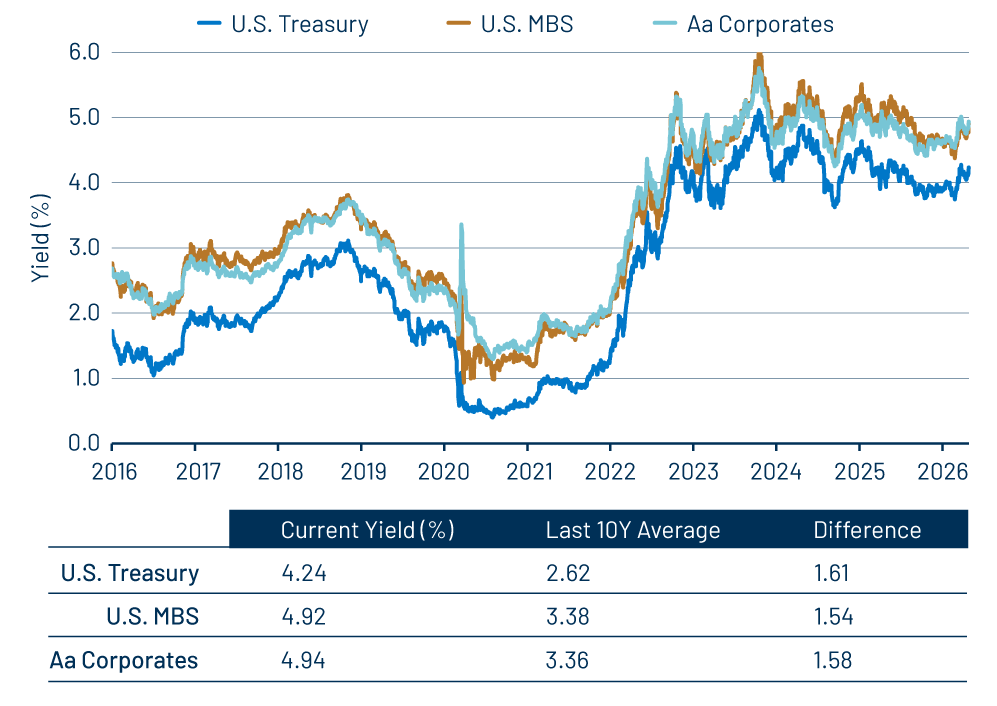
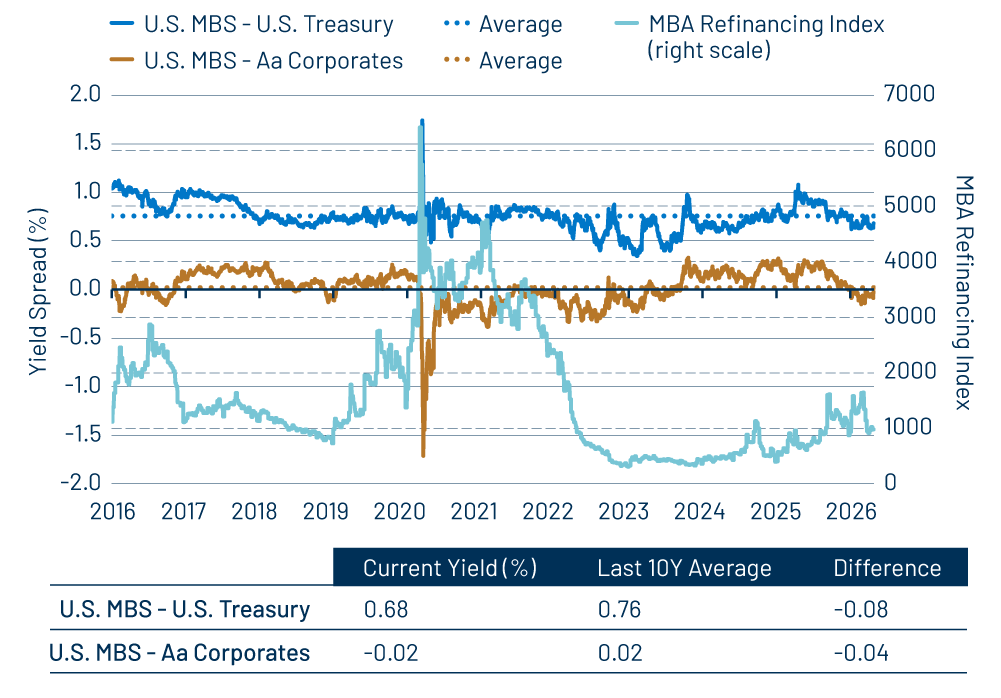
Exhibit 1: The Yield Advantage of Agency MBS (vs. USTs and Corporate Bonds)
The Yield Advantage of Agency MBS (vs. USTs and Corporate Bonds)
Source: Bloomberg, Mortgage Bankers Association (MBA). As of 29 Apr 26. Select the image to expand the view.
Exhibit 2: The Yield Advantage of Agency MBS (vs. Mortgage Refinancing Index)
The Yield Advantage of Agency MBS (vs. Mortgage Refinancing Index)
Source: Bloomberg, Mortgage Bankers Association (MBA). As of 29 Apr 26. Select the image to expand the view.

The yield advantage of agency MBS compensates for prepayment risk, as US mortgage borrowers can repay their mortgage loans in full or in part at any time prior to maturity. This risk factor is tied less to corporate solvency and more to prepayment behavior. This matters because many reserve managers remain understandably cautious about moving further out the risk spectrum. Investment-grade corporate bonds may offer additional spread, but they also introduce exposure to the credit cycle and sector-specific stress. In this context, agency MBS occupies a middle ground between pure sovereign exposure and higher-spread credit sectors. They can complement Treasury holdings without forcing reserve managers into traditional credit risk.

Unlike many other spread sectors, the agency MBS market is deeply tied to consumer confidence, household wealth, banking-system stability and the effectiveness of monetary policy itself. Housing remains one of the most systemically important sectors of the US economy, and agency MBS sits close to the center of that financial plumbing. That systemic importance has historically reinforced the market’s institutional depth and policy relevance during periods of stress—a point reserve managers should not overlook.

Of course, agency MBS carry negative convexity, meaning expected principal and interest cash flows can change as interest rates move. When rates decline, mortgage refinancing activity can accelerate, causing investors to receive principal back sooner than expected. When rates rise, refinancing slows and durations can extend. That extension risk can become uncomfortable in periods of higher interest rate volatility. However, higher rates also work to stabilize the agency MBS market as origination supply, refinancing and prepayment activity drops, and agency MBS income potential becomes more predictable.

Official institutions need to approach the asset class carefully, particularly around coupon selection, benchmark construction, liquidity and duration management. At present, agency MBS allocations remain relatively modest in reserve portfolios compared with Treasuries, while central banks have been gradually broadening the range of eligible reserve assets over the past several years. The World Bank’s RAMP survey on reserve management practices found that MBS are increasingly appearing within eligible reserve investment frameworks, while OMFIF’s Global Public Investor survey showed reserve managers increasingly looking at broader government and quasi-government sectors as part of their reserve allocation process. Additionally, the Fed’s custody holdings for foreign official and international accounts showed over $325 billion in US government agency MBS securities as of April 2026, reinforcing active participation.

In our view, agency MBS fit naturally into the broader evolution taking place in reserve management. The discussion isn’t about replacing Treasuries. It’s about whether reserve managers are using the full US high-quality fixed-income toolkit more deliberately in a world where liquidity, resilience and income generation increasingly need to coexist. For institutions with sufficient reserve buffers and clearly defined investment tranches, agency MBS may offer a more compelling balance between those objectives.

For interested readers, we also highlighted key features of the asset class in our paper, The Advantages of Agency Mortgage-Backed Securities.

© Western Asset Management Company, LLC 2026. The information contained in these materials ("the materials") is intended for the exclusive use of the designated recipient ("the recipient"). This information is proprietary and confidential and may contain commercially sensitive information, and may not be copied, reproduced or republished, in whole or in part, without the prior written consent of Western Asset Management Company ("Western Asset").
Past performance does not predict future returns. These materials should not be deemed to be a prediction or projection of future performance. These materials are intended for investment professionals including professional clients, eligible counterparties, and qualified investors only.
For the Franklin Templeton global-non product disclosures, please click here.
These materials have been produced for illustrative and informational purposes only. These materials contain Western Asset's opinions and beliefs as of the date designated on the materials; these views are subject to change and may not reflect real-time market developments and investment views.
Third party data may be used throughout the materials, and this data is believed to be accurate to the best of Western Asset's knowledge at the time of publication, but cannot be guaranteed. These materials may also contain strategy or product awards or rankings from independent third parties or industry publications which are based on unbiased quantitative and/or qualitative information determined independently by each third party or publication. In some cases, Western Asset may subscribe to these third party's standard industry services or publications. These standard subscriptions and services are available to all asset managers and do not influence rankings or awards in any way.
Investment strategies or products discussed herein may involve a high degree of risk, including the loss of some or all capital. Investments in any products or strategies described in these materials may be volatile, and investors should have the financial ability and willingness to accept such risks.
Unless otherwise noted, investment performance contained in these materials is reflective of a strategy composite. All other strategy data and information included in these materials reflects a representative portfolio which is an account in the composite that Western Asset believes most closely reflects the current portfolio management style of the strategy. Performance is not a consideration in the selection of the representative portfolio. The characteristics of the representative portfolio shown may differ from other accounts in the composite. Information regarding the representative portfolio and the other accounts in the composite are available upon request. Statements in these materials should not be considered investment advice. References, either general or specific, to securities and/or issuers in the materials are for illustrative purposes only and are not intended to be, and should not be interpreted as, recommendation to purchase or sell such securities. Employees and/or clients of Western Asset may have a position in the securities or issuers mentioned.
These materials are not intended to provide, and should not be relied on for, accounting, legal, tax, investment or other advice. The recipient should consult its own counsel, accountant, investment, tax, and any other advisers for this advice, including economic risks and merits, related to making an investment with Western Asset. The recipient is responsible for observing the applicable laws and regulations of their country of residence.
Founded in 1971, Western Asset Management Company is a global fixed-income investment manager with offices in Pasadena, New York, London, Singapore, Tokyo, Melbourne, São Paulo, Hong Kong, and Zürich. Western Asset is a wholly owned subsidiary of Franklin Resources, Inc. but operates autonomously. Western Asset is comprised of six legal entities across the globe, each with distinct regional registrations: Western Asset Management Company, LLC, a registered Investment Adviser with the Securities and Exchange Commission; Western Asset Management Company Ltda. is regulated by Comissão de Valores Mobiliários; Western Asset Management Company Pty Ltd ABN 41 117 767 923 is the holder of the Australian Financial Services License 303160; Western Asset Management Company Pte. Ltd. Co. Reg. No. 200007692R is a holder of a Capital Markets Services License for fund management and regulated by the Monetary Authority of Singapore; Western Asset Management Company Ltd, a registered Financial Instruments Business Operator and regulated by the Financial Services Agency of Japan; and Western Asset Management Company Limited is authorised and regulated by the Financial Conduct Authority ("FCA") (FRN 145930). This communication is intended for distribution to Professional Clients only if deemed to be a financial promotion in the UK as defined by the FCA. This communication may also be intended for certain EEA countries where Western Asset has been granted permission to do so. For the current list of the approved EEA countries please contact Western Asset at +44 (0)20 7422 3000.