
skip navigation
Western Asset Management Company
Blog

Stay up to date on timely topics and market events. Subscribe to our Blog now.

ECONOMY
February 13, 2026

Core Inflation Bounces, Retail Sales Don’t

By Michael J. Bazdarich, PhD

Stay up to date on timely topics and market events. Subscribe to our Blog now.

The Bureau of Labor Statistics (BLS) announced today that Consumer Price Index (CPI) inflation occurred at a 2.1% seasonally adjusted annualized rate in January. However, the more closely watched core CPI bounced to a 3.6% annualized rate in January and a 2.5% rate for the last 12 months. (Core inflation excludes the volatile food and energy components.)

Because of likely technical glitches in reporting of shelter costs, we have been focusing on a core inflation measure that also excludes shelter costs. That measure rose at a 4.4% annualized rate in January and by 2.1% over the last 12 months. (Shelter costs have recently come in more closely aligned with market data on home prices and rents, after diverging widely in 2022 and 2023, so we will likely focus primarily on overall core inflation in months to come.)

Meanwhile, earlier this week, the Census Bureau announced that retail sales were essentially unchanged in December from November, for both the headline and control sales measures. (“Control sales” excludes the volatile and business-oriented car dealer, service station, building supplies and restaurant sectors.)
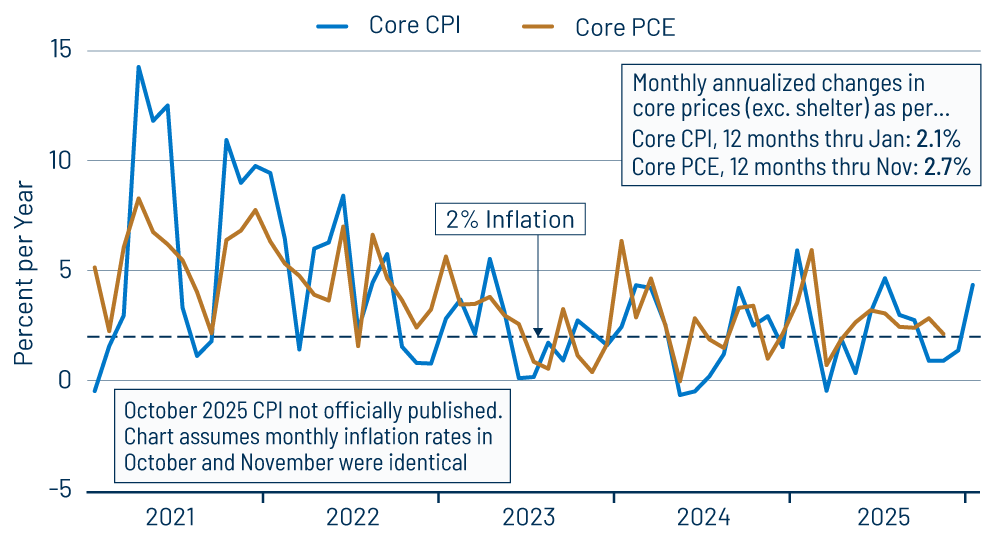
Exhibit 1: Core Inflation, Excluding Shelter—CPI & PCE
Core Inflation, Excluding Shelter—CPI & PCE
Source: Bureau of Labor Statistics, Bureau of Economic Analysis, Western Asset. As of 31 Jan 26. Core Personal Consumption Expenditures (PCE) is the preferred inflation measure of the Federal Reserve. Select the image to expand the view.

Financial analysts had widely anticipated some bounce in CPI inflation in January, and the actual increase may have been smaller than expected. As you can see in Exhibit 1, core CPI also bounced in January 2025, 12 months ago, only to subside thereafter. CPI inflation will also likely subside in the months to come, but note that the January 2025 spike eased, but did not reverse. In other words, the January 2025 spike continued to hold up 12-month inflation rates over the rest of the year, and the same is likely to occur this year. So the successive January spikes should be put in perspective, but not dismissed outright.

In January, goods prices were generally well-behaved, with core goods prices essentially flat (up at a 0.5% annualized rate), food prices up only slightly (2.2% annualized), and energy prices down substantially (-16.2% annualized). However, core prices were elevated by a spike in service costs, with non-energy services up at a 4.8% annualized rate and ex-shelter services (aka ''supercore'') up 7.3% annualized.

Yes, services prices also spiked in January 2025, and much the same ''culprits'' drove the gains in both this January and last January. These sectors were utilities, hospital and doctor fees, car rental costs, sporting event prices and internet fees. For January 2026, airline fares also jumped sharply. Also this month, though, health insurance costs were reported as declining, and a few other service sectors came in milder than a year ago, so that the January 2026 services inflation spike was actually a bit milder than that of January 2025. Here too, these January price spikes will ease in the months to come, but they will keep 12-month inflation rates elevated.

All in all, the January 2026 CPI report is not good news. It is possible/likely that technical factors contributed to the spike, but that just puts the onus on the inflation data in February and beyond to come in more moderately.
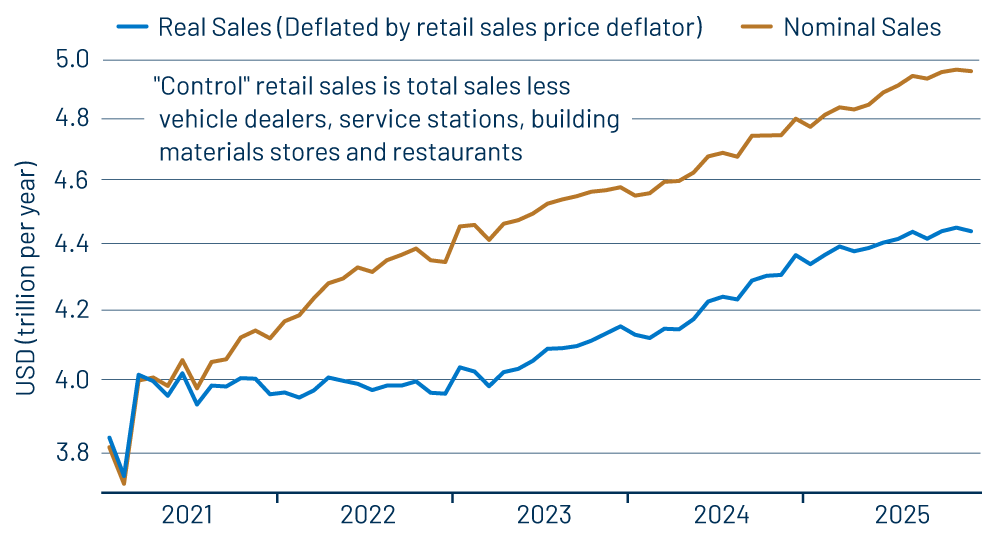
Exhibit 2: “Control” Retail Sales
“Control” Retail Sales
Source: Census Bureau, Bureau of Labor Statistics, Bureau of Economic Analysis, Western Asset. As of 31 Dec 25. Select the image to expand the view.

The soft December retail sales report came on the heels of a downbeat November sales report as well. We saw a similar late-summer “lull” in sales activity, only to see a strong rebound in October. A similar rebound is likely in early-2026, given that personal income gains have been healthy. Also, as we have discussed before, Christmas season sales data are especially hard to seasonally adjust, and that might be an issue with the December data. On the other side of the ledger, especially cold winters have restrained January sales in years past, and extremely cold and snowy recent weather in the eastern US could work to restrain early-2026 sales.

In sum, there are a lot of factors in play in the retail sales data for the time being, and it could be a while before we get a clear picture on things. There is no reason to expect emerging weakness, but, for now, the soft sales reports over the last two months are cause for concern.

For what it is worth, the softer sales were focused at furniture stores, online retailers, drug stores and, to a lesser extent, grocery stores and restaurants. No sector showed particularly strong sales in November/December.

The fact that we are discussing January CPI inflation and December retail sales likely reminded you of our remark last time that the Census Bureau is about a month behind the BLS in catching up its releases from the effects of the shutdown. To catch up, Census will have to report two months’ worth of sales (and other indicators) in a single month. No word yet from them on when that might occur.

© Western Asset Management Company, LLC 2026. The information contained in these materials ("the materials") is intended for the exclusive use of the designated recipient ("the recipient"). This information is proprietary and confidential and may contain commercially sensitive information, and may not be copied, reproduced or republished, in whole or in part, without the prior written consent of Western Asset Management Company ("Western Asset").
Past performance does not predict future returns. These materials should not be deemed to be a prediction or projection of future performance. These materials are intended for investment professionals including professional clients, eligible counterparties, and qualified investors only.
For the Franklin Templeton global-non product disclosures, please click here.
These materials have been produced for illustrative and informational purposes only. These materials contain Western Asset's opinions and beliefs as of the date designated on the materials; these views are subject to change and may not reflect real-time market developments and investment views.
Third party data may be used throughout the materials, and this data is believed to be accurate to the best of Western Asset's knowledge at the time of publication, but cannot be guaranteed. These materials may also contain strategy or product awards or rankings from independent third parties or industry publications which are based on unbiased quantitative and/or qualitative information determined independently by each third party or publication. In some cases, Western Asset may subscribe to these third party's standard industry services or publications. These standard subscriptions and services are available to all asset managers and do not influence rankings or awards in any way.
Investment strategies or products discussed herein may involve a high degree of risk, including the loss of some or all capital. Investments in any products or strategies described in these materials may be volatile, and investors should have the financial ability and willingness to accept such risks.
Unless otherwise noted, investment performance contained in these materials is reflective of a strategy composite. All other strategy data and information included in these materials reflects a representative portfolio which is an account in the composite that Western Asset believes most closely reflects the current portfolio management style of the strategy. Performance is not a consideration in the selection of the representative portfolio. The characteristics of the representative portfolio shown may differ from other accounts in the composite. Information regarding the representative portfolio and the other accounts in the composite are available upon request. Statements in these materials should not be considered investment advice. References, either general or specific, to securities and/or issuers in the materials are for illustrative purposes only and are not intended to be, and should not be interpreted as, recommendation to purchase or sell such securities. Employees and/or clients of Western Asset may have a position in the securities or issuers mentioned.
These materials are not intended to provide, and should not be relied on for, accounting, legal, tax, investment or other advice. The recipient should consult its own counsel, accountant, investment, tax, and any other advisers for this advice, including economic risks and merits, related to making an investment with Western Asset. The recipient is responsible for observing the applicable laws and regulations of their country of residence.
Founded in 1971, Western Asset Management Company is a global fixed-income investment manager with offices in Pasadena, New York, London, Singapore, Tokyo, Melbourne, São Paulo, Hong Kong, and Zürich. Western Asset is a wholly owned subsidiary of Franklin Resources, Inc. but operates autonomously. Western Asset is comprised of six legal entities across the globe, each with distinct regional registrations: Western Asset Management Company, LLC, a registered Investment Adviser with the Securities and Exchange Commission; Western Asset Management Company Ltda. is regulated by Comissão de Valores Mobiliários; Western Asset Management Company Pty Ltd ABN 41 117 767 923 is the holder of the Australian Financial Services License 303160; Western Asset Management Company Pte. Ltd. Co. Reg. No. 200007692R is a holder of a Capital Markets Services License for fund management and regulated by the Monetary Authority of Singapore; Western Asset Management Company Ltd, a registered Financial Instruments Business Operator and regulated by the Financial Services Agency of Japan; and Western Asset Management Company Limited is authorised and regulated by the Financial Conduct Authority ("FCA") (FRN 145930). This communication is intended for distribution to Professional Clients only if deemed to be a financial promotion in the UK as defined by the FCA. This communication may also be intended for certain EEA countries where Western Asset has been granted permission to do so. For the current list of the approved EEA countries please contact Western Asset at +44 (0)20 7422 3000.