


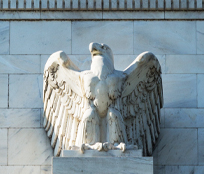
In Jerome Powell’s final meeting as chair of the Federal Reserve (Fed), the Federal Open Market Committee (FOMC) voted to keep the target range for the federal funds rate unchanged at 3.50%–3.75%. While the decision was widely expected, the split vote highlighted an increasingly divided committee and the complications that come with responding to yet another inflationary supply shock.
Only modest revisions were made to the prepared statement since the last FOMC meeting, though they carried a slightly hawkish tilt. The characterization of inflation was firmed from “somewhat elevated” to simply “elevated,” while assessments of economic activity and the labor market were largely unchanged.
For the first time since 1992, four voting members dissented from today’s policy decision. Fed Governor Stephen Miran, as expected, again voted in favor of a 25-basis-point rate cut. In contrast, regional bank presidents Beth Hammack, Neel Kashkari and Lorie Logan supported holding rates steady but took a more hawkish stance by opposing language in the statement that signals a broader easing bias. Their dissent hit on a theme noted in prior meeting minutes that a growing number of committee members now prefer to frame the next policy move as a more balanced, two-sided discussion, rather than focusing primarily on the timing of the next rate cut.
In the press conference, Powell preemptively delivered the day’s biggest surprise, stating that he intends to remain on the Board of Governors “for a period of time to be determined” after his term as chair ends on May 15. He stated that the decision to do so reflects concern that ongoing legal challenges could undermine the Fed’s ability to conduct monetary policy free from political influence. Powell added that as a governor, he plans to “keep a low profile,” allowing Kevin Warsh to assume the roles of chair of both the Federal Reserve Board and the FOMC. His decision to remain on the Board for the time being (and until 2028 at the latest) now requires Governor Miran to step aside to make room for Warsh.
Away from the discussion about the Fed chair transition, Powell fielded a lot of questions around the perceived division among the committee, his current characterization of the Fed’s dual mandate and how the FOMC might respond to yet another inflationary supply shock. In many cases, his overarching message was one of heightened uncertainty and an emphasis on being appropriately positioned to respond to the incoming data. On the dual mandate, Powell characterized the labor market as showing “more and more signs of stability” while it’s been the inflation side of the mandate that’s been “misbehaving.” In response to when the next rate cut might be appropriate, Powell stated that he’d want to see the “back side” of energy-related inflation and “progress on tariffs” before that again becomes a prominent discussion.
Today’s rate decision leaned hawkish and markets reacted accordingly, with 2-year yields pushing back up toward 4.00%. While we agree that inflation is likely to remain well above target over the next several months, the outlook beyond that is less clear and could be shaped by other factors such as an unexpected peace deal involving Iran, demand-side effects from higher oil prices and/or a further softening in labor market conditions. Against this backdrop, our base case continues to call for an extended pause, ultimately followed by further policy easing in late 2026 or early 2027.